


If your association website gets traffic but isn't converting prospects or engaging members, you likely need to improve your existing resources rather than a complete overhaul. Many associations have functional websites and content but struggle with low conversion rates and member engagement. The issue often lies in the strategy behind the technology, not the technology itself.
Member engagement and conversion are closely linked. Prospects are more likely to join if they see active members, and current members who find consistent value are more likely to renew. Engaged members can also become your best marketing asset through word-of-mouth.
In this article, you’ll discover how to audit your current tools, optimize your digital assets, and develop an engagement strategy that effectively converts prospects and retains valued members.
Why Your Website Isn't Converting (And How to Fix It)
When should you optimize your existing website versus rebuilding it completely?
Optimize first. Most associations need strategic improvements and better marketing tactics, not a complete redesign. Rebuild only if your site has structural problems or outdated technology that can't support modern functionality.
Before investing in optimization, understand what's actually broken. Use a diagnostic approach that combines quantitative data with qualitative member insights. Here's how to conduct that audit systematically.

Part 1: Diagnose Before You Optimize
Effective optimization starts with understanding both what your members are doing (analytics) and why they're doing it (research and feedback).
Start With Your Analytics: What the Data Reveals
Your website analytics tell you exactly where prospects and members are struggling, but only if you know what to look for. Start by examining these critical data points:
Traffic sources and conversion: Which channels drive visitors who actually convert to members? One association found that their paid social ads drove significant traffic but converted at only 0.8%, while organic search drove 4.2% conversion. That insight let them reallocate their marketing budget for better ROI. Don't just measure traffic volume—measure quality.
Conversion funnel drop-offs: Map the path from first visit to signup, then identify where people drop off. Are they leaving on page two of your signup form? Viewing pricing but never clicking "Join"? Tools like Google Analytics 4, Hotjar, or Microsoft Clarity show exactly where friction exists.
Member behaviour patterns: How often do members log into your portal, and what do they use? If analytics show only 15% of members have accessed your expensive resource library, you've identified both an engagement opportunity and a potential budget reallocation.
Email and mobile performance: Track which email subject lines and content types drive engagement, and whether certain segments ignore your messages. If 60% of your traffic comes from mobile but your mobile conversion rate is half your desktop rate, you've found a critical optimization priority.
Complement Data With Member Research
While analytics tell you what's happening, they rarely explain why. That's where direct member research becomes invaluable. Use these three approaches to get a complete picture:
Surveys for breadth: Send targeted surveys to different member segments—new members, long-time members, members who haven't logged in recently, and members who didn't renew. Keep surveys short and focused, asking questions that inform specific optimization decisions.
Interviews for depth: Schedule 20-30-minute conversations with members at different engagement levels. Ask open-ended questions that uncover their motivations, frustrations, and unmet needs. One professional association discovered, through interviews, that members loved the quality of the resources but found the website search function so frustrating that many had stopped looking for content.
User testing for usability: Watch real people—both prospects and members—try to complete common tasks on your website. Can prospects easily find pricing information and understand what they'll get? Can members quickly register for an event or download a resource? You'll be surprised by what seems obvious to you but confuses first-time users.
Conduct a Competitive Analysis
Look at what other successful associations in your industry or adjacent fields are doing with their digital presence. What content formats are they using? How do they structure their pricing and membership tiers? What engagement tactics are they using on social media? You're not copying their strategy—you're identifying best practices and opportunities to differentiate yourself.
Once you've gathered analytics data, member feedback, and competitive insights, look for patterns. Where do multiple data sources point to the same problem? Those are your highest-priority optimization opportunities.
Part 2: Website Optimization Strategies That Drive Conversions
Small, data- and member-research-informed changes to your website can dramatically improve conversion rates without a complete rebuild.
Conversion rate optimization (CRO) is the process of increasing the percentage of website visitors who take your desired action, whether that's joining, registering for an event, or downloading a resource. Here's how to approach it strategically:
Identify your conversion bottlenecks. Based on your analytics audit, where are people dropping off? Common problem areas include confusing or overwhelming navigation, unclear value propositions that don't answer "Why join?", signup forms that ask for too much information too soon, pricing pages that hide costs or lack transparency, slow page load speeds that frustrate users before they engage, and poor mobile experiences that make key actions difficult on phones.
Prioritize based on impact and effort. Not all optimizations are equally valuable. Focus first on high-traffic pages with conversion goals, such as your homepage, membership/pricing page, and key landing pages. Quick wins like improving page speed or clarifying your calls-to-action should come before complex projects like rebuilding your entire navigation structure.
A/B test systematically. Never make assumptions about what will work. Test one variable at a time so you know what actually drove improvement. Common elements worth testing include headlines and value proposition copy, call-to-action button text and color, form length and field order, page layouts and visual hierarchy, images and social proof elements, and pricing presentation.
Personalization and Segmentation Strategies
Generic experiences don't engage anyone deeply. Modern website platforms and marketing automation tools make personalization possible even for mid-sized associations.
Segment your audiences with precision. At a minimum, create distinct experiences for prospects versus current members. More sophisticated segmentation might include: membership tier (student, professional, executive, corporate), industry focus or specialty area, career stage (emerging professional vs. established leader), geographic region, and engagement level (highly active, moderately engaged, at-risk).
Personalize content dynamically. Use your website platform's capabilities to show different content based on whether someone is logged in, their membership status, or their behaviour. For example, prospects might see testimonials and "Join Now" calls-to-action, while logged-in members see their personalized dashboard and relevant upcoming events.
Create targeted landing pages. Rather than sending all traffic to your generic homepage, build specific landing pages for each campaign and audience. A landing page for young professionals considering membership should look and feel different from one for senior executives, with distinct messaging, imagery, and emphasized benefits.
Optimize Your Most Critical Pages
Homepage: Your homepage needs to serve multiple audiences at once, including prospects, members, and administrators. Use a clear visual hierarchy to direct each audience to their destination. Feature your strongest value proposition prominently. Show evidence of an active, engaged membership through upcoming events, recent content, or member success stories.
Membership/Pricing Page: This is typically your highest-value conversion page. Make your pricing completely transparent. Hiding costs until someone contacts you kills conversions. Clearly differentiate membership tiers with specific, tangible benefits for each level. Use comparison tables that make the decision easier. Include strong social proof through member testimonials, logos of member organizations, or impressive statistics about your membership base.
Member Portal/Dashboard: Once someone joins, their portal experience determines whether they'll engage and renew. Personalize the dashboard to show content relevant to their profile, interests, or membership tier. Surface the underutilized benefits they haven't accessed yet. Make common tasks, such as event registration or resource downloads, require minimal clicks. Show their activity and engagement over time to reinforce the value they're receiving.
Technical Optimizations That Matter
Don't overlook technical factors that impact both user experience and search engine rankings:
Page speed: Even a one-second delay in load time can reduce conversions by 7%. Use tools like Google PageSpeed Insights to identify and fix performance issues. Compress images, minimize code, leverage browser caching, and consider a content delivery network (CDN) for faster global access.
Mobile optimization: With more than half of web traffic coming from mobile devices, your site must work well on phones and tablets. Test all critical conversion paths on multiple devices and screen sizes.
Search functionality: If members can't find your content, it might as well not exist. Implement robust search with filters, auto-suggest, and relevance ranking. Track what people search for to find content gaps or discoverability issues.
Accessibility: Beyond being the right thing to do, accessibility improvements benefit all users. Ensure your site meets WCAG standards with proper heading structure, alt text for images, keyboard navigation, and sufficient colour contrast.
Part 3: Content Marketing That Engages and Converts
Strategic content marketing does double duty—it engages current members while attracting prospects through demonstrated expertise and value.
Build a Content Strategy Tied to Member Lifecycle
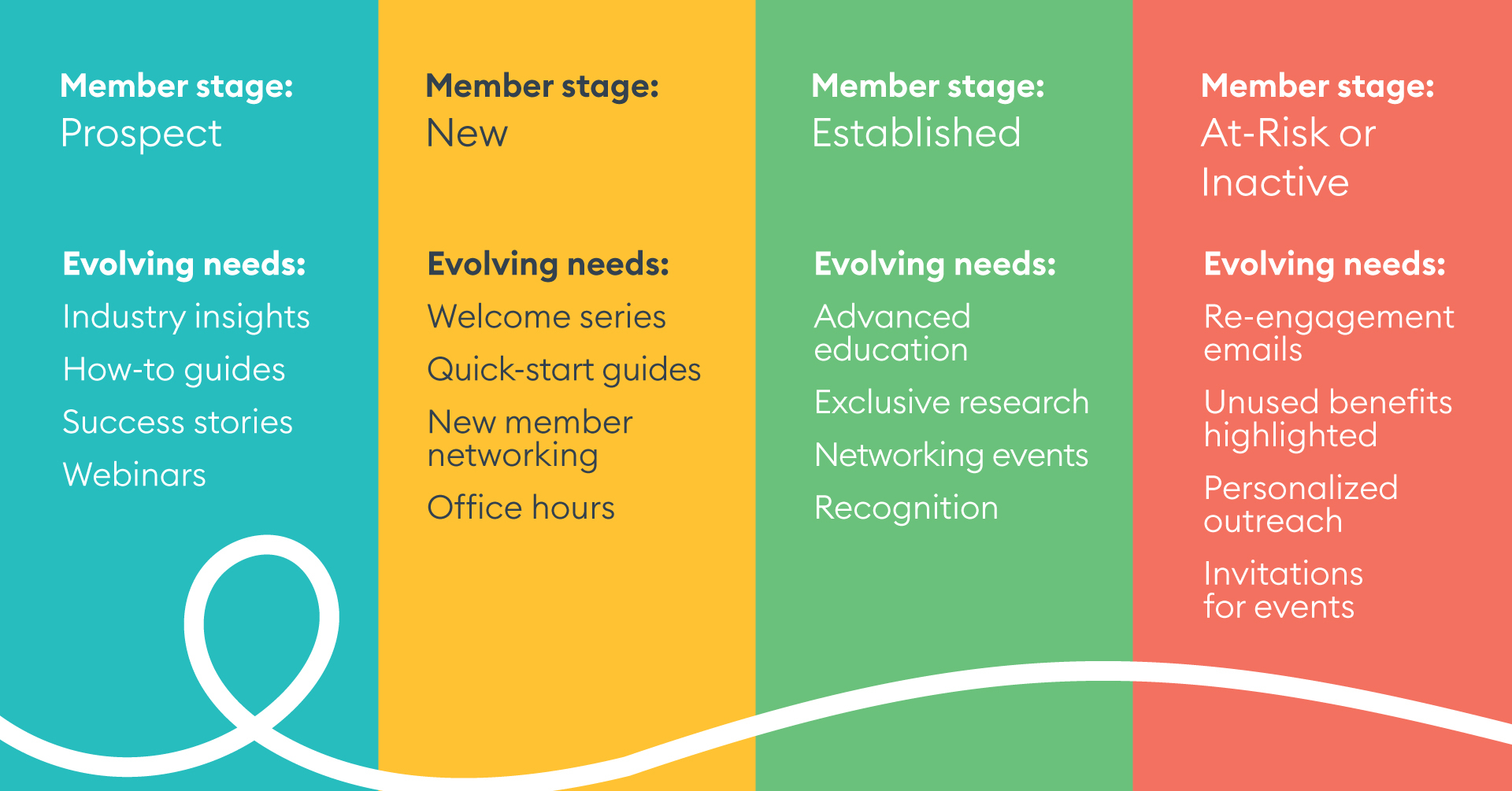
Effective content marketing aligns with your members' journey and addresses their evolving needs.
For prospects (awareness and consideration stage): Create ungated content that demonstrates your expertise and shows the value of membership. This might include: industry insights and trend analysis that showcases your knowledge, practical how-to guides that solve real problems your target members face, member success stories that illustrate tangible outcomes, thought leadership from your organization's experts or prominent members, and introductory webinars or video content that gives prospects a taste of member-only resources.
For new members (onboarding stage): Develop content that helps new members get value quickly. Research shows members who engage within their first 90 days are more likely to renew. Create welcome email series that introduces key resources and benefits, quick-start guides for your most valuable member tools, introductory networking opportunities for new members, and "office hours" or help sessions that reduce friction.
For established members (engagement and retention stage): Provide ongoing value that justifies renewal and keeps members engaged. This includes advanced educational content that helps members grow professionally, exclusive industry data or research they can't get elsewhere, regular networking and community-building opportunities, recognition programs that celebrate member achievements, and timely updates on issues affecting your industry or profession.
For at-risk members (re-engagement stage): When data shows a member hasn't logged in for 60+ days or hasn't engaged with recent content, trigger targeted re-engagement campaigns. Highlight benefits they haven't used, feature new resources or events that match their profile, share success stories from similar members, or offer a direct conversation to understand what they need.
Create Content in Formats Your Members Actually Consume
Your member research should reveal which formats resonate most. Don't assume; test and measure. High-performing formats typically include comprehensive guides and reports that members reference repeatedly, video content for education and social reach, webinars for lead generation and member education, and segmented email newsletters that still deliver among the highest ROI of any marketing channel.
One trade association's annual compensation report became both its most valuable member benefit and strongest conversion tool for prospects—demonstrating how the right content serves dual purposes.
Optimize Content for Search and Discovery
Great content that nobody finds delivers zero value. Focus on keyword research to understand what your members search for, basic on-page SEO with clear headings and meta descriptions, internal linking to connect related content and keep evergreen pieces discoverable, and regularly refreshing high-value older content instead of only creating new pieces.
Develop a Sustainable Content Calendar
Consistency beats volume. One high-quality piece monthly, published reliably, outperforms sporadic bursts of daily content. Build a calendar that aligns with your industry's rhythm and event schedule, balances educational content with member stories and industry news, assigns clear ownership and deadlines, and includes a promotion strategy for each piece. Creating content is only half the battle.
Part 4: Marketing Automation for Member Lifecycle Engagement
Marketing automation allows you to deliver timely, personalized engagement at scale, doing manually what would require a much larger team.
Why Associations Need Marketing Automation
Manual outreach doesn't scale. As your membership grows, you can't personally email every new member, follow up with every inactive user, or send timely renewal reminders to hundreds or thousands of members. Marketing automation solves this by triggering relevant messages based on member behaviour and lifecycle stage.
Essential Automation Workflows for Associations
New member onboarding: The first 90 days are critical. Automate a welcome series that introduces key resources, invites members to events, connects them with relevant groups, and checks in to ensure they're getting value. Start with a welcome email and login info, follow with resource highlights and event invitations, and end with a check-in around day 30 to 60.
Renewal campaigns: Begin outreach 90 days before expiration. Send a "year in review" showing value received, preview what's coming next year, provide one-click renewal links, and follow up with non-renewers, highlighting what they're missing.
Re-engagement sequences: When members haven't logged in for 60 days or more, trigger automated outreach highlighting what they've missed, surveying what would add value, and inviting them to relevant events.
Event automation: Automate from announcement through follow-up—registration confirmations, reminder sequences, post-event thank-yous with recordings, and feedback surveys.
Behaviour-triggered messages: The most powerful automation responds to specific actions in real time. When members download resources, register for events, or hit milestones, trigger relevant follow-up automatically.
Segmentation Makes Automation Effective
Generic automation barely outperforms no automation. Powerful automation segments by membership tier, engagement level, interests or specialty, and lifecycle stage. Tailor messaging so student members receive different content than executives, and highly engaged members get different touchpoints than those at risk of leaving.
Platforms and Tools
If you're starting with automation, platforms like HubSpot, Mailchimp, or ActiveCampaign integrate well with most association management systems. The key is choosing a platform that syncs with your existing AMS so member data flows automatically without manual list syncing.
Link: BC Chamber of Commerce Case Study: How Marketing Automation Improved Member Retention
When to Consider a Complete Rebuild
Sometimes optimization hits its limits, and the structure of your platform or site may be the issue. If you’ve tried optimizing and have identified structural elements that need fixing, it may be time to consider a complete rebuild of your website.
Assess whether any of the following situations apply to your need to build a new website:
- Your current platform cannot support the functionality your members require.
- Technical debt makes even simple changes slow and expensive.
- Your site's architecture does not align with how members actually navigate and use the content.
- The mobile experience is fundamentally broken and cannot be fixed without a complete rebuild.
- Your brand and design are so outdated that they damage your credibility.
- You are spending more on ongoing patches and fixes than the cost of a complete rebuild.
Link: From Idea to Impact: Creating a Membership Site That Grows and Delivers Value (comprehensive guide to rebuilding)
Final Thoughts: Optimization as Your Competitive Advantage
Most associations treat their website and digital marketing as "done" once launched. They create content sporadically, send the same emails to everyone, and make decisions based on opinions rather than data. That's your opportunity.
By committing to continuous optimization through systematic testing, data-informed decisions, and member-centric improvements, you create a compounding advantage over time. Small improvements stack. What starts as a 10% increase in conversion or a 5% boost in retention becomes transformational when sustained over months and years.
The associations that thrive aren't necessarily the ones with the biggest budgets or the flashiest websites. They're the ones that relentlessly focus on understanding their members, delivering value, and optimizing every touchpoint in the member journey.
Ready to identify your highest-impact optimization opportunities?
Join our free webinar where we'll walk through the diagnostic framework we use with association clients to prioritize improvements that actually move the needle on conversion, engagement, and retention.

Related posts

.jpg)